Wednesday, July 17, 2013

Entrada para mi clase de 4090


Rotación 2: Ordeñar

         Me desperté a las 4:30 de la mañana de la semana pasada a ordeñar las vacas en UGA Costa Rica. Tenía mis dudas sobre esto porque yo nunca había ordeñado una vaca antes, porque eso significaría haber estado cerca de uno antes. Sinceramente, creo que Marlon, la persona a cargo de las vacas y la leche, no estaba teniendo el mejor día porque era un poco de mal humor por la mañana. Pero es comprensible, tener que levantarse muy temprano cada mañana, debe ser difícil. Mi primer trabajo de esa mañana fue limpiar los pisos antes de que nos llevamos más de una vaca. A veces, si las vacas no están familiarizados con una persona, que puede hacer pis o caca o conseguir inquietos. Así Marlon comenzar esta operación primero y luego me enseñó a hacerlo. El ordeño es definitivamente una habilidad practicada. Yo estaba sólo gotas mientras Marlon estaba haciendo enormes chorros de leche. En general, fue una curiosa experiencia. La leche que se adquirió fue utilizado por la mañana para el desayuno. Cuando se lo dimos a la cocina hervían la leche, desnatada de la parte superior y luego se vierte en recipientes que se utilizará para la crema para el café. Hubo satisfacción inmediata!


          [I woke up at 4:30 in the morning a couple weeks ago to milk the cows at UGA Costa Rica. I was hesitant about this because I had never milked a cow before, because that would mean having been close to one before. I honestly think Marlon, the person in charge of the cows and their milk, wasn’t having the best day because he was a little bit cranky that morning. But it’s understandable, having to wake up super early every morning must be hard. My first job that morning was to clean the floors before we brought over a cow. Sometimes, if they are not familiar with a person, they can pee or poop or get antsy. So Marlon started milking first and then showed me how to do it. Milking is definitely a practiced skill. I was getting mere droplets while Marlon was getting huge blasts of milk. Overall it was a neat experience. The milk we acquired was used that morning for breakfast. When we gave it to the kitchen they boiled the milk, skimmed off the top and then poured it in containers to be used for creamer for our coffee. There was immediate gratification!]


Entrada para mi clase de 4090

Rotación 4: Biblioteca

        Ayer Neil y yo trabajamos a organizar la biblioteca del centro comunitario. Buscamos a través de cada libro, que supongo que se ha donado a la biblioteca, y escribimos el nombre del autor, el título del libro y el número ISBN. No era un trabajo difícil. Neil y yo estábamos realmente dedicados a terminar la gran caja de libros y finalmente lo hicimos! Mientras que no estábamos haciendo mucho, me sentí como que estábamos ayudando a la comunidad de San Luis, de alguna manera. Me gusta mucho el hecho de que la comunidad se está juntos para dar el material de lectura a los niños y personas de todas las edades, que tienen el deseo de leer.
        Estoy emocionada de ver que nuestro trabajo será puesto en uso cuando nuestra clase va al centro de la comunidad el sábado para ver a los hijos de San Luis. Esperemos que nos leyéndoles los animará a continuar leyendo por su cuenta. Creo que sólo hay dos más pequeñas cajas que quedan de los libros que tenemos que poner en inventario para el siguiente grupo o dos de la clase asignada a la biblioteca debe ser capaz de acabar con él.


[Yesterday Neil and I worked organizing the library for the community center. We looked through each book, that I suppose has been donated to the library, and wrote down the author's name, the title of the book, and the ISBN number. It wasn't difficult work. Neil and I were really dedicated to finishing the huge box of books and eventually we did! While we were not doing much, I felt like we were helping the San Luis community in some small way. I really like the fact that the community is getting together to give reading material to the children, and people of all ages, that have the desire to read. 
         I'm excited to see that our work will be put to use when our class going to the community center on Saturday to read to the children of San Luis. Hopefully us reading to them will encourage them to continue reading on their own. I think there are only two more small boxes left of the books that we need to put into inventory so the next group or two of our class assigned to the library should be able to finish it off.]

Entrada para mi clase de español 3050


         Lingüística se puede definir como "el estudio científico del lenguaje y su estructura, incluyendo el estudio de la morfología, la sintaxis, la fonética y semántica." En términos más simples, el estudio del lenguaje es como el estudio de los seres humanos. Cada especie en este planeta tiene su propia forma de comunicación. Es fácil confundir el estudio del lenguaje como un estudio de la comunicación, y de alguna manera lo es. Sin embargo, no todas las formas de comunicación pueden ser clasificados como lingüística. Las expresiones faciales o lenguaje corporal no son formas de un lenguaje lingüístico. La comunicación no verbal puede contar con hasta un 90% de una conversación. El vídeo que vemos en clase dio muchos ejemplos, pero también he recogido algunos por mi cuenta. La ropa que nosotros, como estadounidenses, llevamos todo el tiempo y consideramos normal, no encuentran tan a menudo en Costa Rica. Chicas en los Estados Unidos llevan pantalones cortos todo el tiempo, especialmente cuando hace calor. Sin embargo, aunque no hay duda de humedad y calor aquí, es raro cuando me encuentro a una chica de Costa Rica con pantalones cortos. En realidad, muchos de los costarricenses aquí tomarlo como una señal de que somos de los Estados Unidos cuando llevamos pantalones cortos. Una gran cantidad de Ticas aquí lleva pantalones muy ajustados, pero pantalones cortos no son tan comunes.

        También un símbolo de la comunicación no verbal que es muy común es sutilmente rascando un área alrededor de la boca. Esto ocurre generalmente cuando usted está comiendo. Si usted mira a un amigo, hacer contacto visual, y luego sutilmente rayar un área alrededor de la boca, por lo general su amigo se toma como una señal de que hay algo en su boca que necesita ser limpiado.

El lenguaje está en constante evolución. Hemos pasado de movimientos de la mano como nuestra principal forma de comunicación, de un lenguaje evolucionado que en ciertos aspectos, implica un montón de argot. Sin embargo, movimientos de la mano todavía se utilizan hoy en día. Yo, personalmente, utilizo gestos con las manos mucho al hablar. Movimientos de las manos muestran pensamiento instantáneo mientras que las palabras vocalizadas se pueden retrasar. Las expresiones faciales,un otro forma de comunicación no verbal, se utilizan todos los días, todo el tiempo. Estas son las características principales de nuestras emociones. Esta muestra puede ocurrir sin palabras. Nuestros rostros pueden decir lo que sentimos, pero no necesariamente lo que estamos pensando. La sonrisa es en realidad la expresión más fácil de reconocer, verdadero disfrute. Hay seis expresiones que son universales, como la felicidad, el miedo, la tristeza, el disgusto, la sorpresa y la ira, lo que indica que las expresiones son innatas y no se inclinaron. Con todo, como el lenguaje, en general, está en constante evolución, lo que significa la lingüística, el estudio del lenguaje, está evolucionando también.


        [Linguistics can be defined as “the scientific study of language and its structure, including the study of morphology, syntax, phonetics, and semantics.” In simpler terms, the study of language is like the study of human beings. Each species on this planet has its own form of communication. It is easy to confuse the study of language as a study of communication, and in some ways it is. But not all forms of communication can be classified as linguistic. Facial expressions or body language are not forms of a linguistic language. Nonverbal communication can count up to 90% of a conversation. The video we watch in class gave lots of examples, but I have also picked up a few on my own. The clothes that we, as Americans, wear all the time and consider normal, aren’t as often found in Costa Rica. Girls in the United States wear shorts all the time, especially when it’s hot outside. I do not mean super short shorts, but shorts in general. Yet, although there is definitely humidity and heat here, it is rare when I come across a Costa Rican girl wearing shorts. Actually, a lot of Costa Ricans here take it as a sign we are from the United States when we wear shorts. A lot of Ticas here wear really tight pants, but shorts just aren’t as common. Also a symbol of nonverbal communication that is extremely common is subtly scratching an area around your mouth. It happens usually when you’re eating. If you look at a friend, make eye contact, and then subtly scratch an area around your mouth, generally your friend will take it as a sign that there is something on their mouth that needs to be cleaned. 
Language is constantly evolving. We have moved from hand motions as our primary way of communication, to an evolved language that in certain aspects, involves a lot of slang. Yet, hand motions are still used today. I, personally, use hand gestures a lot when speaking. Hand motions show instantaneous thought while vocalized words can be delayed. Facial expressions, another form on nonverbal communication, are used every day, all the time. They are the primary feature of our emotions. This showing can occur without words. Our faces can tell what we’re feeling, but not necessarily what we are thinking. The smile is actually the easiest expression to recognize, true enjoyment. There are six expressions that are universal, such as happiness, fear, sadness, disgust, surprise and anger; which indicates that expressions are innate and not leaned. All in all, as language in general is constantly evolving, that means linguistics, the study of language, is evolving as well.]


Entrada para mi clase de español 3050


Muchas personas hablan en dialectos diferentes dependiendo de su lugar de origen. Es el mismo caso en Costa Rica. Aunque he acostumbrado a la fluidez de todos, algunas cosas todavía me llaman la atención. Como Dr. Mata demostró un par de veces en la clase,o cuando se le preguntó a Lily para demostrar su pronunciación de una palabra, los costarricenses no utilizan la vibrante multiple [r]. Cuando dicen perro, pronuncian [peɹo]. Pero a través de claves de contexto, yo soy capaz de darse cuenta de que significa un sustantivo y no un conjunto. 
Mucha gente en mis principios clases de español tuvo problemas utilizar la vibrante multiple [r], por lo que Costa Rica sería muy bueno para ellos! Es una locura cuando se piensa que muchos de los países dicen que hablan español, pero cada uno tiene su propia adaptación de la lengua. Los costarricenses en realidad no utilizan la vibrante multiple [r]. En España, la [θ] sonido es muy importante cuando se trata de decir un montón de palabras con [c].
         [Many people speak different dialects depending on their place of origin. It is the same case in Costa Rica. Although I have become accustomed to the fluidity of all the people, some things still catch my attention. As Dr. Mata showed a couple of times in class, or when Lily was asked to show her pronunciation of a word, Costa Ricans do not use multiple vibrant [r]. When they say dog, they pronounce [peɹo]. But through context clues, I am able to realize that they mean a noun and not a conjunction.
         Many people in my beginning Spanish classes had problems using multiple vibrant [r], so I think Costa Rica would be a great place for them! It's crazy when you think that many of the countries say they speak Spanish, but each has its own adaptation of the language. Costa Ricans do not really use the multiple vibrant [r]. In Spain, the [θ] sound is very important when trying to say a lot of words with [c].]

Friday, July 5, 2013

Explorando San Jose -Entrada para mi clase de 4090


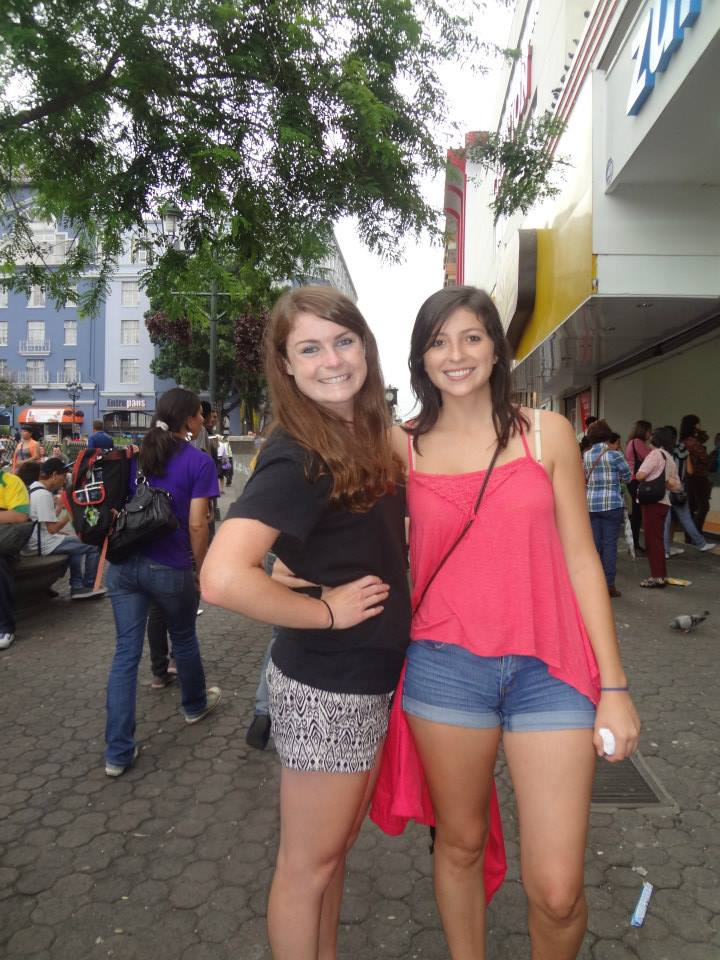
           Pues tomamos una semana de descanso de la escuela y viajamos por Costa Rica. La primera parada fue San José. Wow. Nunca he estado en Nueva York, así que supongo que nunca he estado en una ciudad enorme legítimamente. Pero vaya, San José parecía enorme para mí! Era una locura. Yo también tenía mi teléfono robado la primera noche, que sin duda a la altura de mis ideas de la vida en una gran ciudad. Pero el primer día nos dimos una vuelta por la ciudad, tenía un tour y se pasó el día recorriendo todas las tiendas. Mientras nos divertimos, definitivamente terminó el día confirmando el estereotipo de que los costarricenses van a mentir a usted en lugar de decir "no sé". Después de preguntar a varias personas cómo llegar a nuestro hotel, terminamos caminando más de un kilómetro en un gran círculo. Fue genial porque no sólo tuve un montón de ejercicio inesperado, pero también tiene una ducha libre desde que comenzó a verter. Pero no te preocupes, en el tercer día de explorar San José tuve la oportunidad de volver a nuestro hotel, con demasiada confusión.

P.S  También encontramos a alguien que era bueno en pintando las caras, por lo que sólo añadido a nuestro extranjero que-no-pertenencia-aquí apariencia.


          [Well we took a week off from school and traveled around Costa Rica. First stop was San Jose. Wow. I have never been to New York so I guess I have never been to a legitimately huge city. But geez, San Jose seemed HUGE to me! It was crazy. I also had my phone stolen the first night, which definitely lived up to my ideas of life in a big city. But the first day we just walked around the city, had a tour and spent the day touring all the shops. While we had fun, I definitely ended the day confirming the stereotype that Costa Ricans will lie to you rather than tell you "I don't know." After asking multiple people how to get back to our hotel, we ended up walking over a mile in a huge circle. It was great because not only did I get a ton of unexpected exercise, but I also got a free shower since it started pouring. But no worries, by the third day of exploring San Jose I was able to get back to our hotel with too much confusion.

P.S. We also found someone who was good at face painting, so that only added to our foreign-we-don't-belong-here look.]


Caminando alrededor de Santa Elena


          En una de nuestras tardes libres escasos, un par de nosotros fuimos a Santa Elena. Está a unos 20 minutos de San Luis, y tienes que tomar un taxi para llegar allí. Mientras que Santa Elena no es enorme, por cualquier medio, sin duda es grande en comparación con San Luis. Con una población de ~ 350 personas en San Luis, Santa Elena parece como la ciudad de Nueva York. De todos modos, nos pasamos casi toda la tarde sentado en el borde de una carretera que pasa por alto las montañas y el golfo. Fue increíble y muy impresionante. También fuimos a un restaurante y disfrutamos de unas hamburguesas americanas. Fue un gran día.


         [On one of our scarce free afternoons, a couple of us went to Santa Elena. It's about 20 mins from San Luis, and you have to take a taxi to get there. While Santa Elena isn't huge by any means, it's definitely big in comparison to San Luis. With a population of ~350 people in San Luis, Santa Elena seems like New York city. Anyway, we spent most of the afternoon sitting on an edge of a road that overlooked the mountains and gulf. It was incredible and so breath taking. We also went to a restuarant and enjoyed some American burgers. It was a really great day.]


Mi familia maravillosa - Entrada para mi clase de 4090


           Tiempo viaja tan rápido aquí! No puedo creer que cuatro semanas ya han pasado de largo. Pero dentro de este tiempo aquí, he disfrutado realmente vivir con mi familia. Ellos viven en un hogar muy humilde y su estilo de vida es muy diferente a lo que estoy acostumbrado en los Estados Unidos. Son una familia tan cariñosa y generosa. Mi cumpleaños fue el 25 de junio y no me esperaba mucho. Tuve dos pruebas para estudiar y un papel para escribir, y mi cumpleaños no era la principal prioridad para el día. Cuando llegué a casa a las siete, mi madre de acogida, Marina, me había hecho tilapia, *americano* puré de papas y verduras. El pescado es un plato más caro, así que era el único en la familia que comió esa noche. Ella dijo que quería hacerme una cena yo realmente disfrutar antes de mi grupo de estudio fue de pasar una semana en San José. La cena fue increíble, pero lo que hizo realmente especial fue cuando toda la familia salió de la cocina con un pastel de cumpleaños cantando "Feliz Cumpleaños". Yo estaba tan sorprendido y muy feliz. Era una cosa tan increíblemente agradable de hacer y lo que realmente hizo que mi día. Estoy muy contento de que yo era la suerte de tener una familia increíble.


          [Time travels so fast here! I can't believe four weeks have already passed by. But within this time here, I have really enjoyed living with my host family. They live in a very humble home and their lifestyle is very different from what I am used to in the States. They are such a caring and generous family. My birthday was June 25, and I didn't expect much. I had two tests to study for and a paper to write, and my birthday wasn't the biggest priority for the day. When I got home at seven, my host mom, Marina, had made me tilapia, *american* mashed potatoes, and vegetables. Fish is a more expensive dish, so I was the only one in the family that ate it that night. She said she had wanted to make me a dinner I would really enjoy before my study group left to spend a week in San Jose. The dinner was amazing, but what made it really special was when the whole family walked out of the kitchen with a birthday cake singing "Happy Birthday." I was so shocked and so happy. It was such an incredibly nice thing to do and it really made my day. I am so glad that I was so lucky to get such an amazing host family. ]